
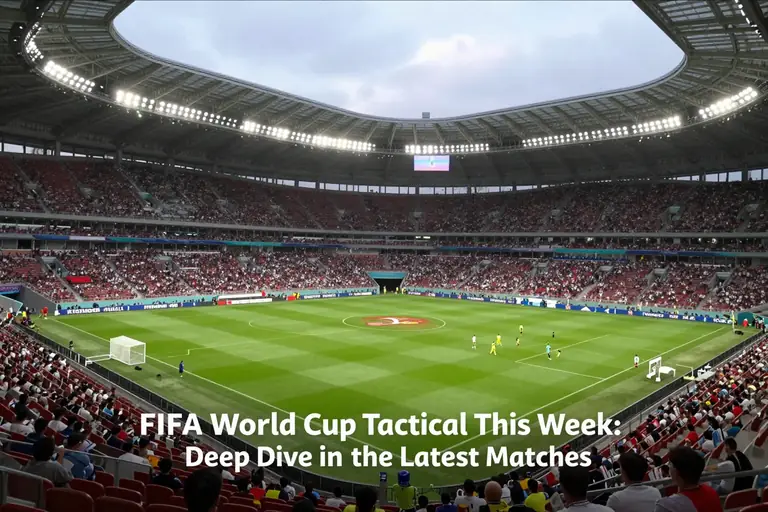
FIFA World Cup Tactical Analysis This Week: Unpacking the Latest Strategies and Game-Changing Moments
The FIFA World Cup, a quadrennial spectacle of global football, consistently delivers not just drama and passion, but also a rich, evolving tapestry of tactical ingenuity. For the discerning football enthusiast and analyst, each match is a high-stakes chess game, where coaches meticulously plan their moves, counter-moves, and strategic gambits. This past week has been no exception, offering a fascinating array of tactical battles that demand a thorough FIFA World Cup Tactical Analysis This Week. From the shock results that defied expectations to the dominant performances that solidified reputations, the underlying strategies employed by each nation tell the real story behind the scorelines.
The Art of the High Press: A Double-Edged Sword in Modern Football
One of the most defining and frequently debated tactical approaches in contemporary football is the high press. We observed several teams attempting to implement this aggressive, energy-intensive strategy in the recent fixtures. The fundamental idea behind a high press is deceptively simple: suffocate the opponent in their own half, force hurried decisions and turnovers close to their goal, and subsequently create immediate, high-probability scoring opportunities. When executed with precision, coordination, and relentless effort, it transforms into a terrifying weapon, capable of dismantling even the most composed defenses. However, as our FIFA World Cup Tactical Analysis This Week unequivocally highlights, it is also a strategy fraught with significant risks and demands immense physical fortitude.
Consider a standout match where Team A deployed an incredibly intense and suffocating high press for the initial 25 minutes of the game. Their forwards and central midfielders hunted in coordinated packs, leaving absolutely no time or space for the opposition defenders to comfortably build play from the back. This relentless pressure directly led to two quick goals, purely stemming from winning the ball in dangerous areas high up the pitch. The atmosphere in the stadium was electric; it appeared to be a masterclass in modern, proactive football. Yet, the inherent challenge of maintaining such an astronomical level of intensity for a full 90 minutes is physically grueling and almost unsustainable. As the game progressed into the second half, visible signs of fatigue began to set in amongst Team A’s players. The once-coordinated press became less cohesive, creating significant gaps in midfield and leaving their defensive lines vulnerable. Team B, a side renowned for their patient build-up play and lightning-quick transitions, shrewdly exploited these newly emerging spaces. They bypassed the now-disjointed press with long, incisive diagonal balls aimed at their pacy wingers, who then ran directly at the exposed full-backs. This astute tactical shift by Team B completely turned the game on its head, ultimately proving that even the most effective and seemingly invincible strategies possess inherent vulnerabilities when faced with adaptability and endurance. This particular tactical evolution and its consequences certainly stood out as a critical learning point in our FIFA World Cup Tactical Analysis This Week.
Midfield Dominance: The Unsung Key to Control and Creativity
In a significant number of the recent World Cup clashes, the fiercely contested battle for midfield supremacy proved to be the single most decisive factor in determining the outcome. Teams that successfully managed to assert control over the center of the park consistently dictated the tempo of the game, generated a higher volume of attacking chances, and effectively limited their opponent’s ability to launch meaningful attacks. This crucial aspect of the game extends far beyond merely winning tackles or intercepting passes; it encompasses intelligent positioning, rapid and accurate ball distribution, and the sophisticated ability to switch the play effectively across the width of the pitch. Our FIFA World Cup Tactical Analysis This Week reveals several compelling examples where midfield mastery was paramount.
Let’s examine the encounter between Team C and Team D. Team C opted for a robust three-man midfield configuration, anchored by a deep-lying playmaker who expertly orchestrated attacks from behind, flanked by two energetic box-to-box midfielders. This dynamic duo provided both vital defensive cover, shielding the backline, and significant attacking impetus, making late runs into the opposition box. This midfield trio worked in near-perfect harmony, forming intricate passing triangles to retain possession under intense pressure and launching incisive, defense-splitting passes into the final third. Team D, in stark contrast, deployed a flatter, less dynamic two-man midfield, which quickly became overwhelmed and outnumbered. They struggled immensely to win individual duels, were frequently outmaneuvered in central areas, and found themselves constantly chasing shadows for extended periods of the match. The inevitable result was a comfortable and deserved victory for Team C, largely attributable to their superior and more effective midfield setup. This particular aspect of tactical superiority is undeniably vital for any comprehensive FIFA World Cup Tactical Analysis This Week, highlighting the engine room’s importance.
The collective ability of midfielders to disrupt opposition play, win crucial second balls, and transition seamlessly and rapidly from defensive duties to attacking thrust is often the true engine room of a successful tournament team. Coaches who astutely prioritize and cultivate excellence in this area consistently see their teams flourish, as was demonstrably evident in several key matchups this week. This level of granular detail and understanding of positional play is absolutely crucial for a truly comprehensive FIFA World Cup Tactical Analysis This Week.
Defensive Resilience and Counter-Attacking Prowess: The Underdog’s Weapon
While the allure of attractive, attacking football often captures the headlines and garners widespread admiration, the often-understated art of solid, disciplined defending coupled with lethal counter-attacking remains an incredibly potent and effective force in the high-stakes environment of tournament football. Some teams are absolute masters at absorbing sustained pressure, frustrating their technically superior opponents, and then striking with ruthless, clinical precision on the break. This tactical approach proved particularly effective and yielded surprising results in some of the underdog victories witnessed this week.
Team E, widely considered the significant underdog against the much-fancied and star-studded Team F, delivered a tactical masterclass in defensive organization and swift transitions. They operated with an exceptionally deep and compact defensive block, frequently having all 11 players behind the ball whenever Team F was in possession. Their two central defenders were truly exceptional, winning virtually every aerial duel, making countless crucial blocks, and demonstrating immense positional awareness. The full-backs maintained tight defensive lines, diligently preventing any penetration down the flanks. What truly elevated their strategy, however, was their lightning-quick transition from defense to attack. As soon as they won possession, they launched rapid, incisive counter-attacks, often leveraging the searing pace of their wingers and a single, clinical striker. Team F, despite dominating possession statistics and registering a high number of shots, struggled immensely to break down Team E’s resilient and well-drilled defense. Ultimately, they fell victim to two perfectly executed counter-attacks, leading to a stunning upset. This serves as a classic and compelling example of how a meticulously drilled defensive unit, combined with an effective and efficient counter-attacking strategy, can overcome technically superior opponents. This kind of nuanced, pragmatic play is always a highlight in our FIFA World Cup Tactical Analysis This Week.
The Impact of Substitutions: Game Changers or Missed Opportunities?
Substitutions in football are far more than simply replacing tired legs; they represent critical tactical decisions that possess the profound ability to alter the entire trajectory and outcome of a match. A coach’s acumen in identifying tactical weaknesses, introducing players who can expertly exploit them, or shoring up a struggling area of the pitch often defines their overall tactical brilliance. This week provided several brilliant examples of game-changing substitutions that swung momentum, as well as a few that left spectators and analysts scratching their heads in bewilderment.
In one particularly nail-biting encounter, a coach, with his team trailing by a single goal with just 20 minutes remaining, boldly introduced an attacking midfielder known for his creativity and directness. This substitution immediately injected a much-needed surge of creativity, urgency, and unpredictability into the team’s play. The new player’s uncanny ability to find pockets of space between the lines, combine with teammates, and deliver incisive, defense-splitting passes directly led to the crucial equalizer and, remarkably, the eventual winning goal. It was a high-risk, high-reward move that paid off handsomely, showcasing the coach’s tactical bravery. Conversely, another coach, with his team holding a comfortable lead, made a series of overly defensive substitutions that appeared to inadvertently invite pressure from the opposition. This allowed the trailing team to gain significant momentum, ultimately scoring two late goals and transforming a seemingly sure victory into a nervy, disappointing draw. These contrasting moments vividly underscore the fine line that exists between tactical genius and costly miscalculation, a constant and captivating theme when conducting a FIFA World Cup Tactical Analysis This Week.
Set Pieces: Unlocking the Most Resilient Defenses
In matches where defenses are exceptionally well-organized, compact, and opportunities from open play are scarce, set pieces ascend to an incredibly important tactical weapon. Corners, direct and indirect free-kicks, and even strategically placed long throw-ins can be meticulously planned routines, designed with surgical precision to create crucial scoring opportunities. Our FIFA World Cup Tactical Analysis This Week observed several pivotal goals originating directly from expertly executed set-piece situations.
One particular team demonstrated exceptional prowess and tactical sophistication from corner kicks. They employed a clever blocking routine, designed to create a clear pathway and space for their towering center-back to attack the ball aggressively at the back post. This precisely executed routine resulted in a crucial goal that finally broke the deadlock in an otherwise tightly contested and frustratingly even match. Another side skillfully utilized a short free-kick routine that cunningly caught their opponents off guard, leading directly to a clear shot on goal from a dangerous area. The meticulous attention to detail and countless hours spent practicing these intricate routines can often be the subtle yet significant difference between a frustrating draw and a vital victory, especially in the unforgiving knockout stages where margins are incredibly fine. It is a testament to the comprehensive preparation and strategic foresight that goes into every single game, and certainly merits significant notation in any thorough FIFA World Cup Tactical Analysis This Week.
Player Roles and Adaptability: Beyond the Static Formation
While traditional formations like the 4-3-3, 4-2-3-1, or 3-5-2 provide a fundamental structural framework for a team, it is the highly specific roles assigned to individual players within that system, and their inherent ability to adapt dynamically, that truly brings a tactical plan to vibrant life. Modern football inherently demands immense versatility, with players frequently expected to seamlessly perform different functions and occupy various zones depending on whether their team is in possession of the ball or actively defending.
A shining and particularly illustrative example from this week’s matches involved a talented winger who, when his team had possession, diligently hugged the touchline to provide maximum width and stretch the opposition defense. However, the moment possession was lost, he seamlessly and instinctively tracked back, effectively becoming a second full-back, providing crucial defensive cover and nullifying threats down his flank. This remarkable dual role meant his team maintained both potent attacking width and robust defensive solidity. Similarly, we observed central midfielders dropping deep into their own defensive third to collect the ball from defenders, then driving forward with purpose to join the attack, showcasing immense stamina, tactical awareness, and technical ability. This kind of fluid, intelligent movement and role adaptation makes a team incredibly unpredictable, difficult to press, and ultimately, exceptionally challenging to play against. Understanding and appreciating these individual contributions and their collective impact is a key and fascinating component of any in-depth FIFA World Cup Tactical Analysis This Week.
Looking Ahead: What Tactical Evolutions Can We Expect?
As the FIFA World Cup progresses through its various stages, the stakes will inevitably escalate, becoming higher with each passing match. Coaches will continue to meticulously refine their strategies, analyze their opponents with even greater scrutiny and precision, and tirelessly search for those marginal gains that can ultimately lead to victory and progression. We can confidently anticipate more tactical surprises, bolder and riskier decisions, and even more intense, enthralling battles for midfield supremacy and defensive solidity. The teams that demonstrate the greatest adaptability, both individually in terms of player versatility and collectively in terms of strategic flexibility, will undoubtedly be the ones that advance furthest in this prestigious tournament. Our continued FIFA World Cup Tactical Analysis This Week will remain dedicated to keeping you comprehensively informed on all these evolving trends, strategic shifts, and game-changing moments.
The enduring beauty of football lies not solely in the spectacular goals scored or the gravity-defying saves made, but profoundly in the intricate, captivating dance of strategies and counter-strategies playing out in real-time on the pitch. Every precise pass, every crucial tackle, every impactful substitution is an integral part of a larger, overarching plan. And it is precisely this deep understanding and appreciation of these complex plans that makes watching the beautiful game an even more rewarding and intellectually stimulating experience. So, as we eagerly look forward to the next enthralling round of matches, prepare yourselves for yet another exciting chapter in the FIFA World Cup saga, brimming with tactical intrigue, individual brilliance, and collective determination. We’ll be here, as always, to provide another exhaustive FIFA World Cup Tactical Analysis This Week, delving into all the key moments, strategic shifts, and the tactical narratives that define the world’s greatest football tournament.
FAQ
What are the most common tactical formations used in the FIFA World Cup, and how do they differ?
While there’s a significant degree of fluidity and adaptation, common foundational formations in the FIFA World Cup typically include the 4-3-3 (emphasizing attacking width and pressing), 4-2-3-1 (providing a strong defensive base with a creative attacking midfielder), 3-5-2 (utilizing wing-backs for width and defensive solidity with two strikers), and the traditional 4-4-2 (balanced, often used for direct play or compact defense). Each formation possesses distinct strengths and weaknesses, and coaches often meticulously adapt them based on their available player personnel, the specific strengths and weaknesses of their opponents, and the desired style of play. Our FIFA World Cup Tactical Analysis This Week frequently delves into how these base formations are deployed and modified.
How important is individual player skill in successfully executing a tactical plan at the World Cup level?
Individual player skill is absolutely paramount and inextricably linked to tactical execution. A brilliantly conceived tactical plan, no matter how innovative or theoretically sound, requires players with the requisite technical ability (ball control, passing, shooting), physical prowess (stamina, speed, strength), and footballing intelligence (decision-making, spatial awareness) to execute it effectively under immense pressure. Without highly skilled and intelligent players, even the most sophisticated strategy can quickly unravel and fall apart on the pitch. This symbiotic relationship between strategy and individual talent is a recurring and central theme in any comprehensive FIFA World Cup Tactical Analysis This Week.
Do teams typically stick to one tactical approach throughout the entire World Cup tournament, or do they adapt?
Rarely do successful teams rigidly adhere to a single tactical approach throughout the entirety of a demanding tournament like the World Cup. While teams may possess a preferred or core style of play, successful coaches are almost always pragmatic and adaptable. They will strategically modify and adjust their tactics based on a multitude of factors, including the specific opponent they face, the current scoreline and game state, player availability (due to injuries or suspensions), and even external variables like weather conditions or pitch quality. Flexibility, tactical versatility, and the ability to adapt on the fly are widely considered hallmarks of successful World Cup campaigns, as consistently highlighted and analyzed in our FIFA World Cup Tactical Analysis This Week.